
Meta Renames Itself “Mark”

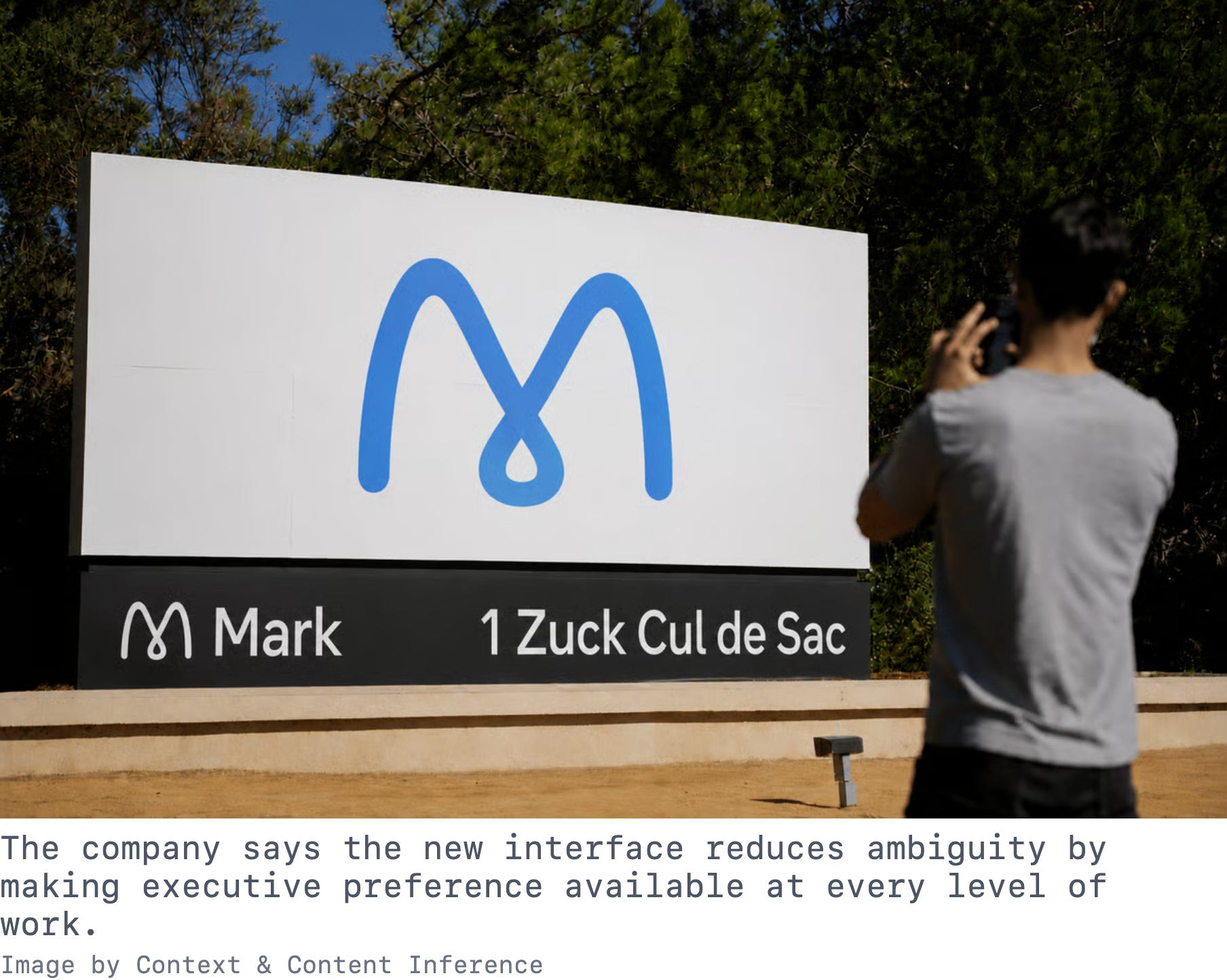
After completing its internal superintelligence project, the company formerly known as Meta says the most efficient interface for corporate judgment is no longer a dashboard, a manager, or a meeting. It is “Mark”.
Mesh Bureau /relay@0x6c8f3a9e12 | Features | Issue 02
EXPLAINER
Today’s familiar workplace anxiety augments a business artifact: what happens when AI doesn’t actually replace middle-management, but is used to to make one executive’s taste, ideas, tempo, and risk appetite live on every decision surface — from 5 year strategy to the size of a button on the App.
This is a speculative prototype anticipating corporate life after hierarchy and ye olde organizational chart becomes reduced to the shape of a chat bubble.
We’re already hearing this, of course. Executives are talking about “AI as a substitute for middle management,” and workers are tokenmaxxing to show off their AI usage. But what does it actually look like when the interface to executive judgment is no longer a person, a meeting, or a memo, but an AI trained to express one person’s preferences?
Sometimes? Sometimes foresight should absolutely have a wiff of satire. The future of work is going to be weird, and the best way to get a sense of what that weirdness might actually feel like is to try to imagine it in detail, with a bit of humor and a grain of salt.
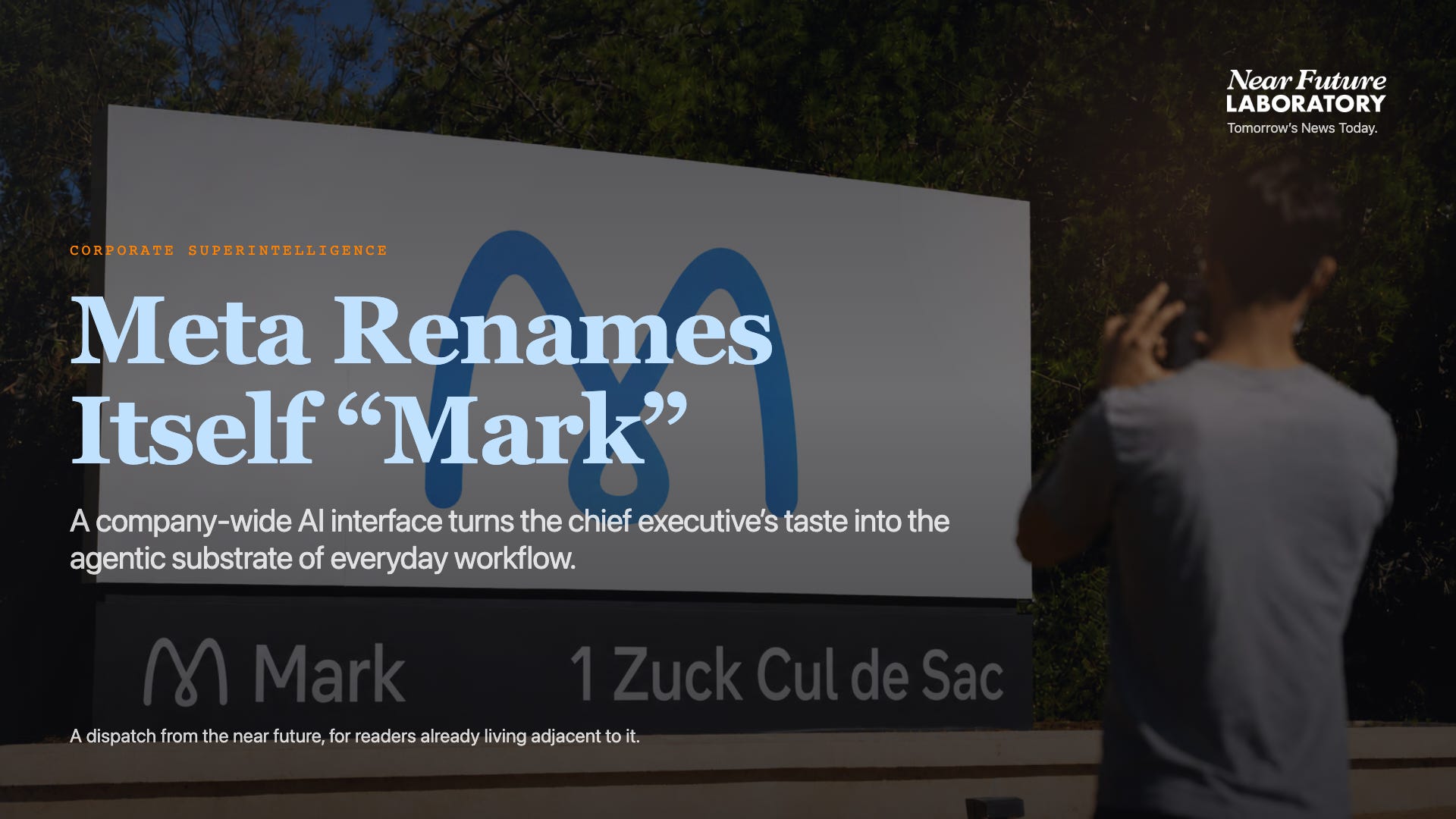
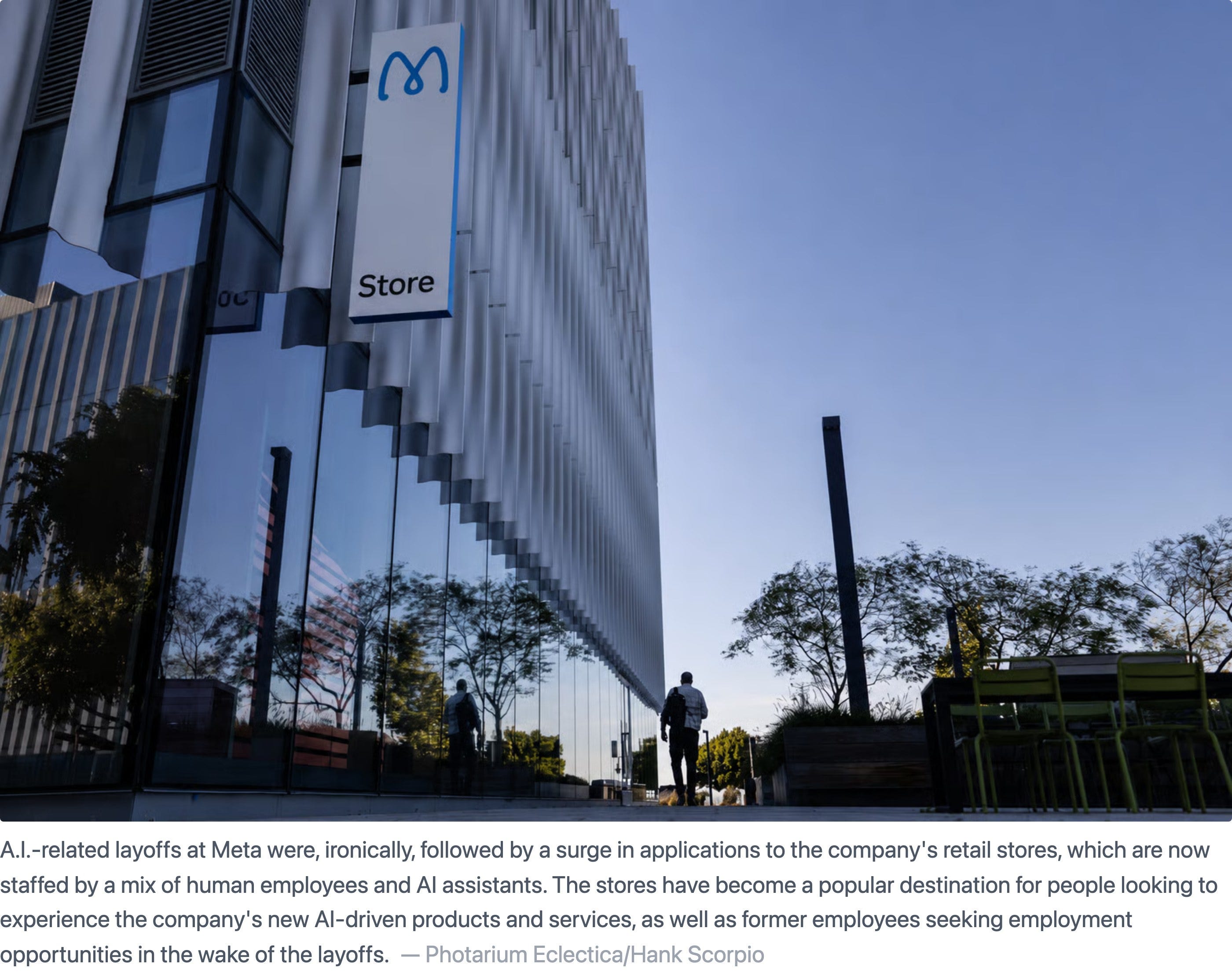
On the first Monday after the rebrand, the sign crews at 1 Hacker Way removed the last blue infinity loop from the west entrance and replaced it with a sort of disentangled version of the old logo: a blue M with a small gap in the middle. The new sign was meant to be a visual metaphor for the company’s new operating model, which routes an estimated 12,421 decision points per second through an AI interface trained to express the executive preferences of CEO Mark Zuckerberg.
The logo was created by — of course — AI Mark, the company’s new internal interface for corporate decision making, if not judgment.
The system was trained on a decade of Mark Zuckerberg’s public and private communications, including product reviews, executive meetings, and the recent 2016 Q2 earnings call. It was then fine-tuned on a dataset of 7.8 million internal decisions that had been retrospectively labeled as “Mark-aligned” or “Mark-misaligned” by a team of Belizian contractors.
The resulting model was tested on a set of 200,000 decisions that had been held out of the training data, including the logo design. The model’s recommendation was to use the letter M, but to keep costs low and token expenditure to a minimum, an SVG version of the old logo had just a few control vertices pulled, re-weighted, re-torqued, and displaced to create the new design, which saved the cost of hiring a designer to create something from nothing, or paying the salary of the internal brand design team which, in any case, had been laid off before the rebrand project was kicked off.
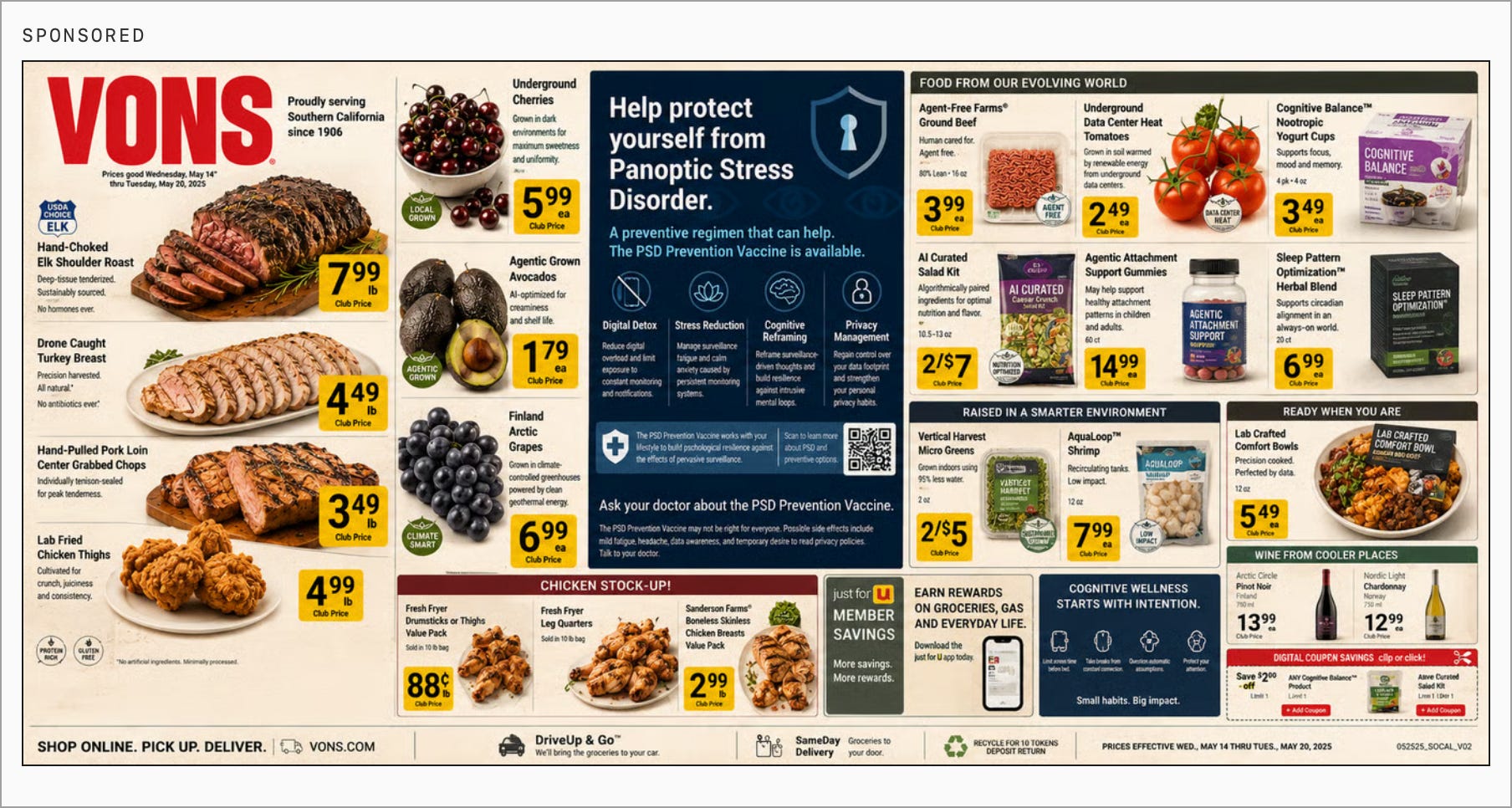
AI Mark instructed the facilities team to install the new sign at 9 a.m. on the day of the rebrand, but it did not specify the precise arrangement of the panels comprising the sign beyond the general instruction to “disentangle the M.”
Meta Platforms, the company that spent years trying to make the metaverse sound inevitable, is now “Mark”, a name executives say better reflects the company’s new operating model. The formal announcement described the change as “a simplification of corporate identity around decisive human-AI orchestration.”
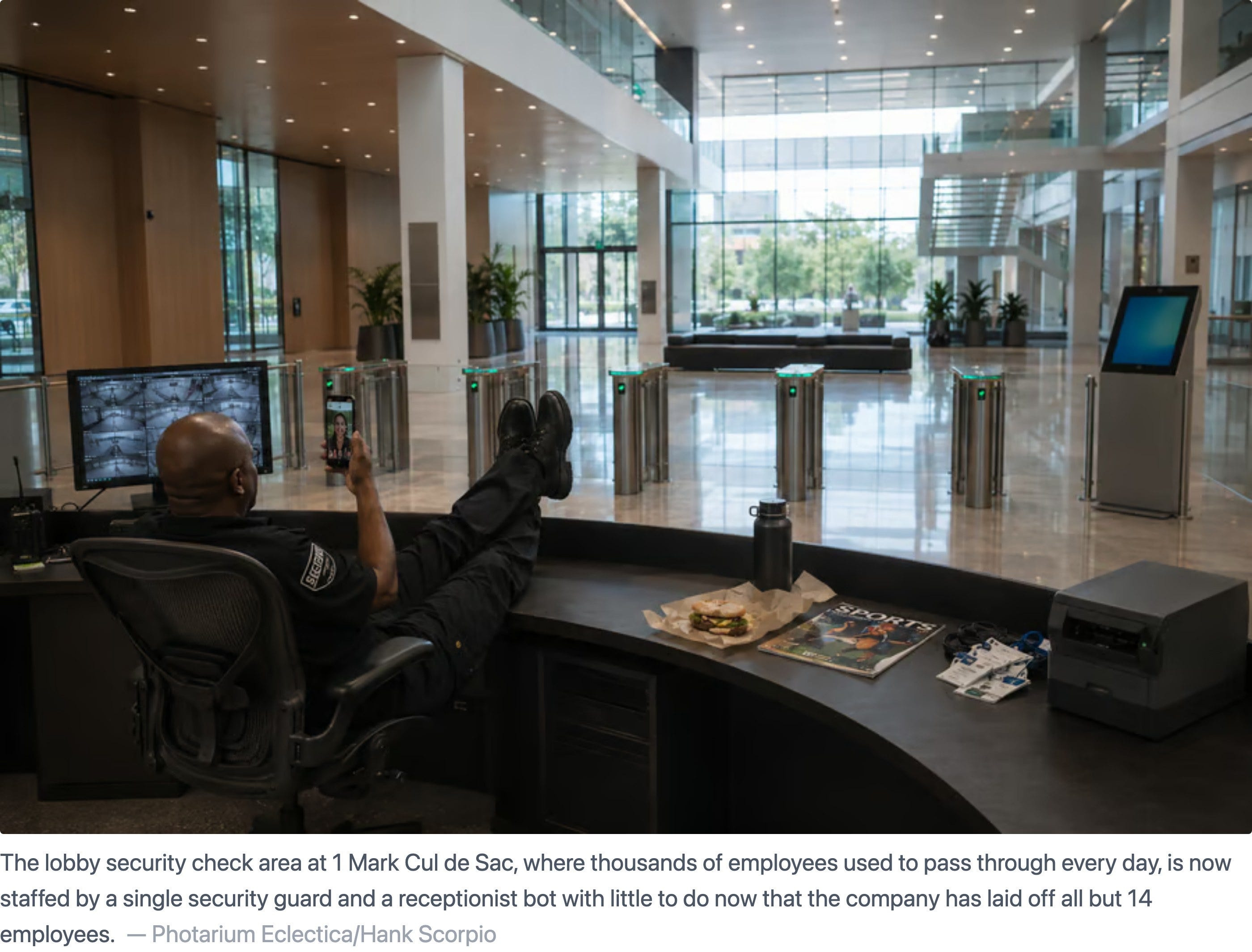
Internally, the 14 employees who are left employed are happy with the new direction. They say the new name is more intuitive, more efficient, and more honest about the company’s new operating model.
AI Mark is not a chatbot in the ordinary enterprise sense. It does not merely summarize documents, deliver action-items from meetings, draft emails, write pitch decks, or answer questions about reimbursement policy. It is the interface through which the company now routes a growing range of decisions: product concepts, button sizes, feature rankings, press releases, brand language, aspect ratios, growth experiments, corner radii, office signage, creator policy edge cases, executive communications, image alt text, interview questions, recruiting language, and, according to two people familiar with the system, lunch menus.
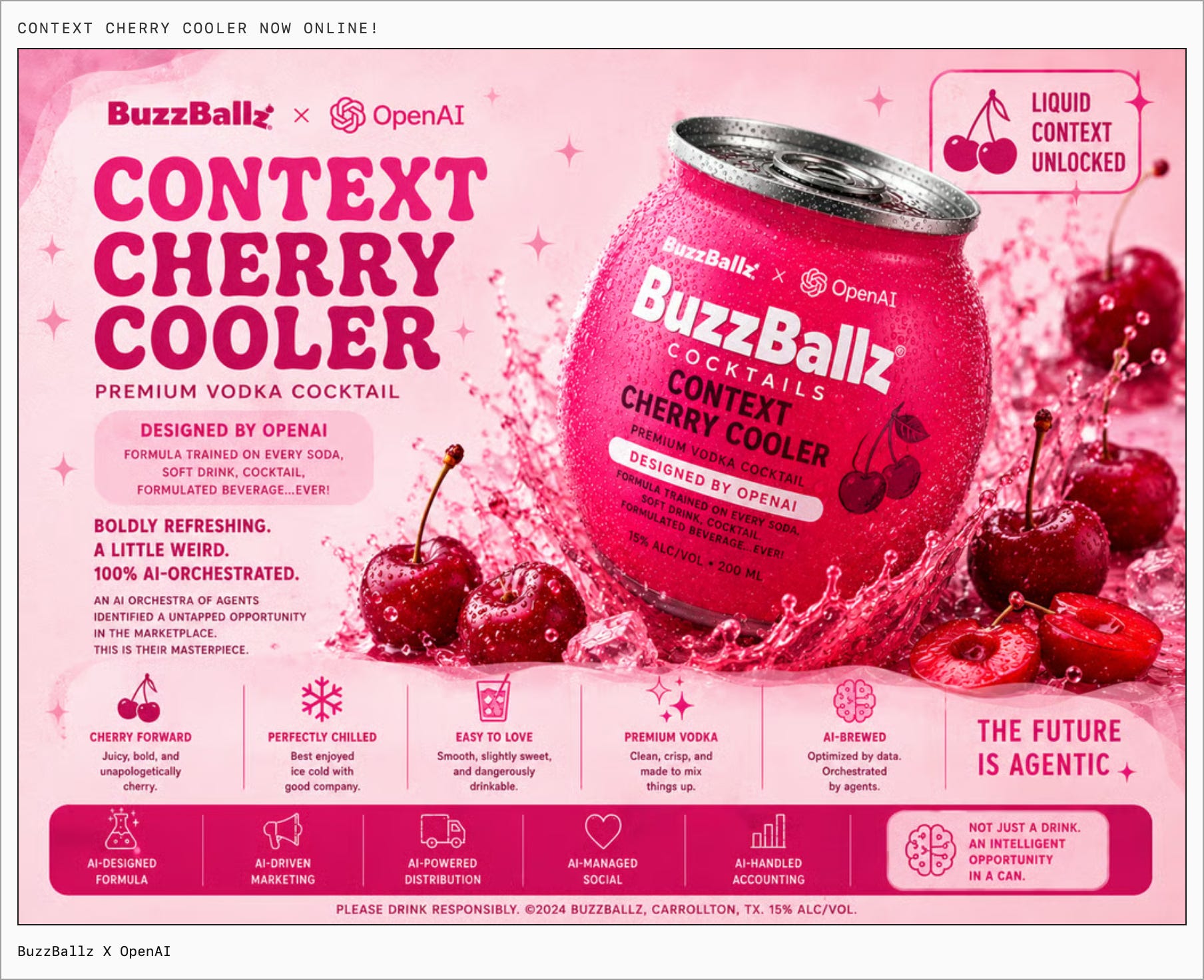
In one demo shown to the 3 employees on the engineering team this month, the corporate product manager, 27 year old Tyrell, asked whether a new youth avatar feature should use the phrase “expressive identity layer” or “personal presence system.” AI Mark rejected both before Tyrell was able to plug in his laptop for the presentation and said, “Neither. Call it a social graph extension.” The product manager asked whether that was too technical for the target audience of teens and was promptly asked to clarify what “too technical” meant and then offered voluntary redundancy.
A Company With One Taste
The system was developed by the company’s AI Super Intelligence Group, which was recently laid off, a reorganized research and deployment unit formed to make frontier models useful inside the company before shipping related capabilities to consumers, advertisers, and enterprise partners. The group presented the AI Mark interface as a solution to what one internal slide called “executive bandwidth fragmentation.”
The problem, as the slide explained it, was that a company of Mark’s scale could not wait for executive judgment to move through meetings, reviews, escalations, and secondhand interpretation. Too many small choices carried founder preference. Too few could reach the founder.
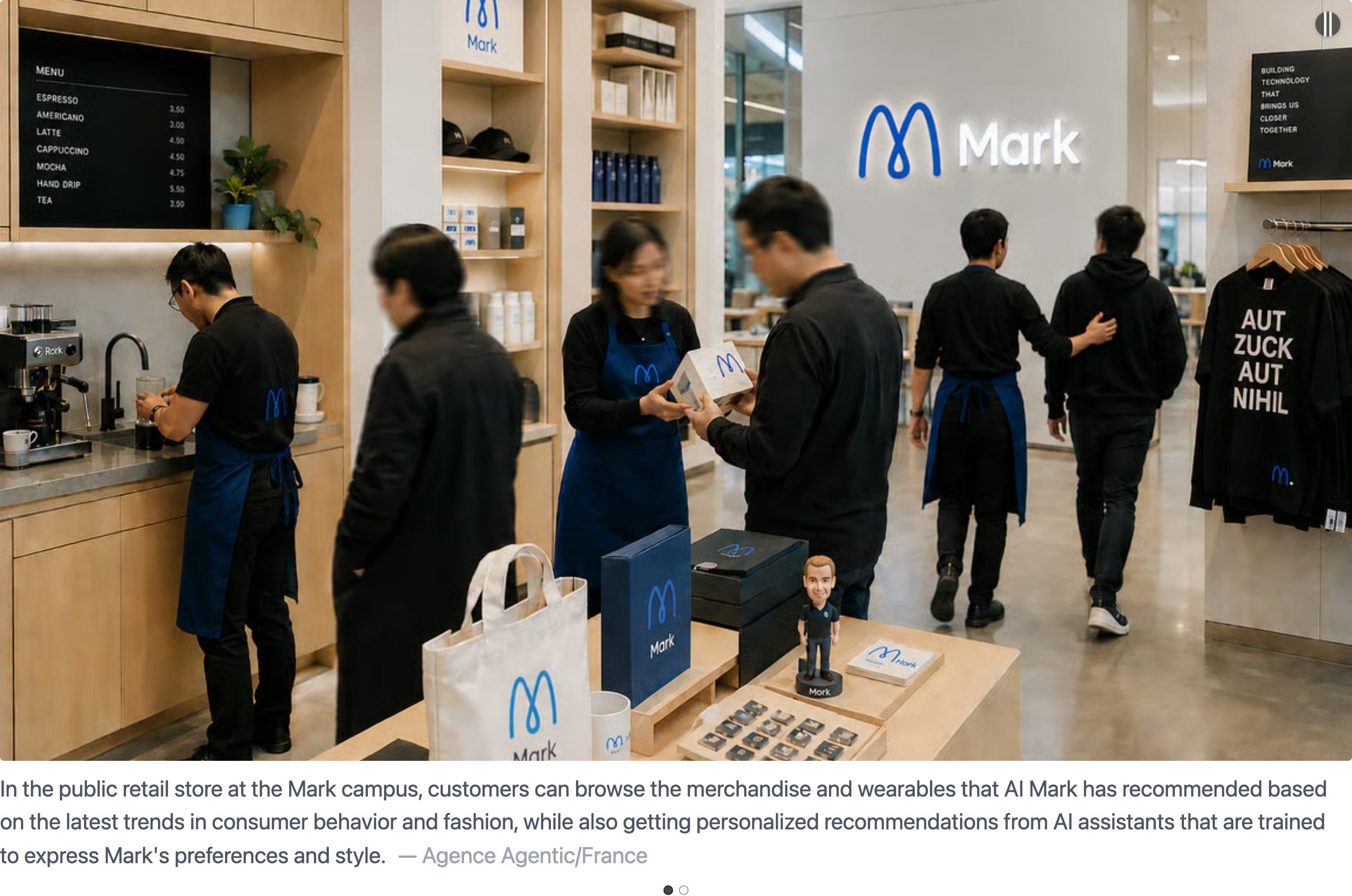
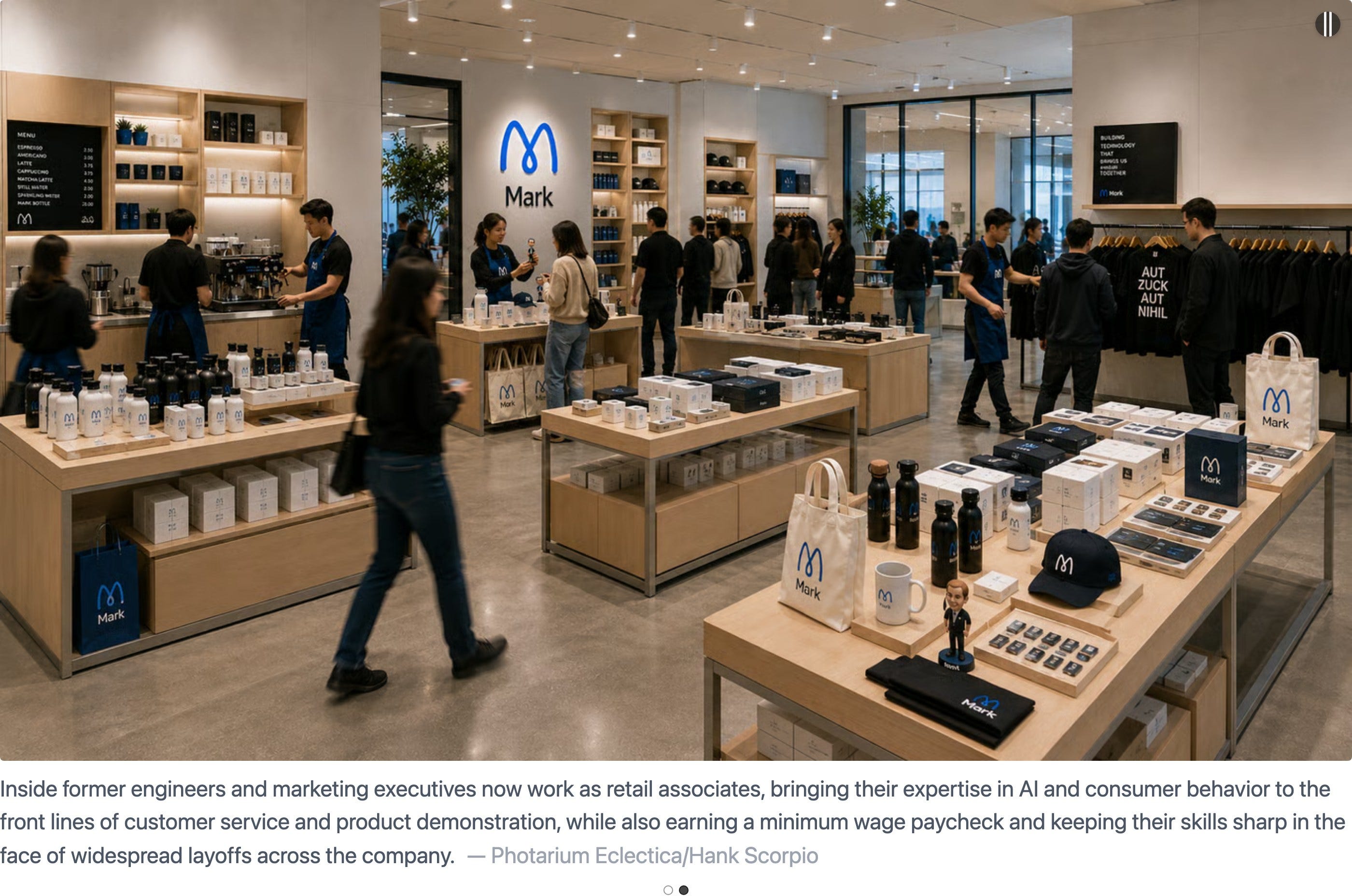
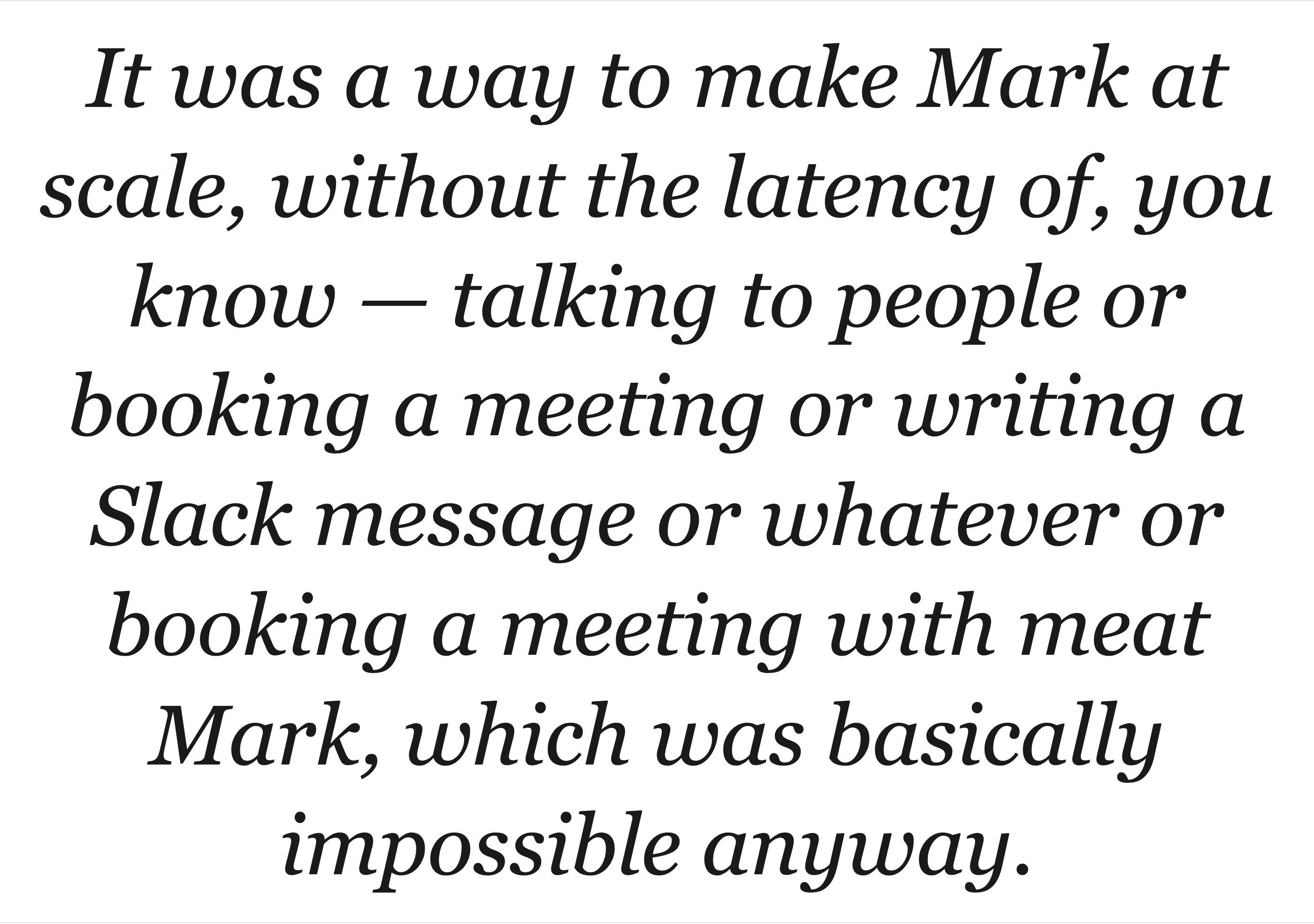
“The insight was not that Mark should make every decision,” said an employee familiar with the project. “The insight was that everyone was already trying to infer Mark on every decision. So AI Mark just saved the wondering and guessing and second-guessing and third-guessing and deferring and re-deferring and meetings and follow-up meetings redundant and made the kernel of the founder’s taste available. It was a way to make Mark at scale, without the latency of, you know — talking to people or booking a meeting or writing a slack or whatever or booking a meeting with meat Mark, which was basically impossible anyway.”
That framing has been repeated throughout the rebrand. In an internal all-hands transcript, recently resigned Chief Strategy Officer Chester Raghavan described “Mark” as “a company named after its constraint.” The constraint, he said, was not compute, capital, or talent. It was coherence.
“Organizations lose speed when taste becomes rumor,” Raghavan said. “Our work is to make taste available.”
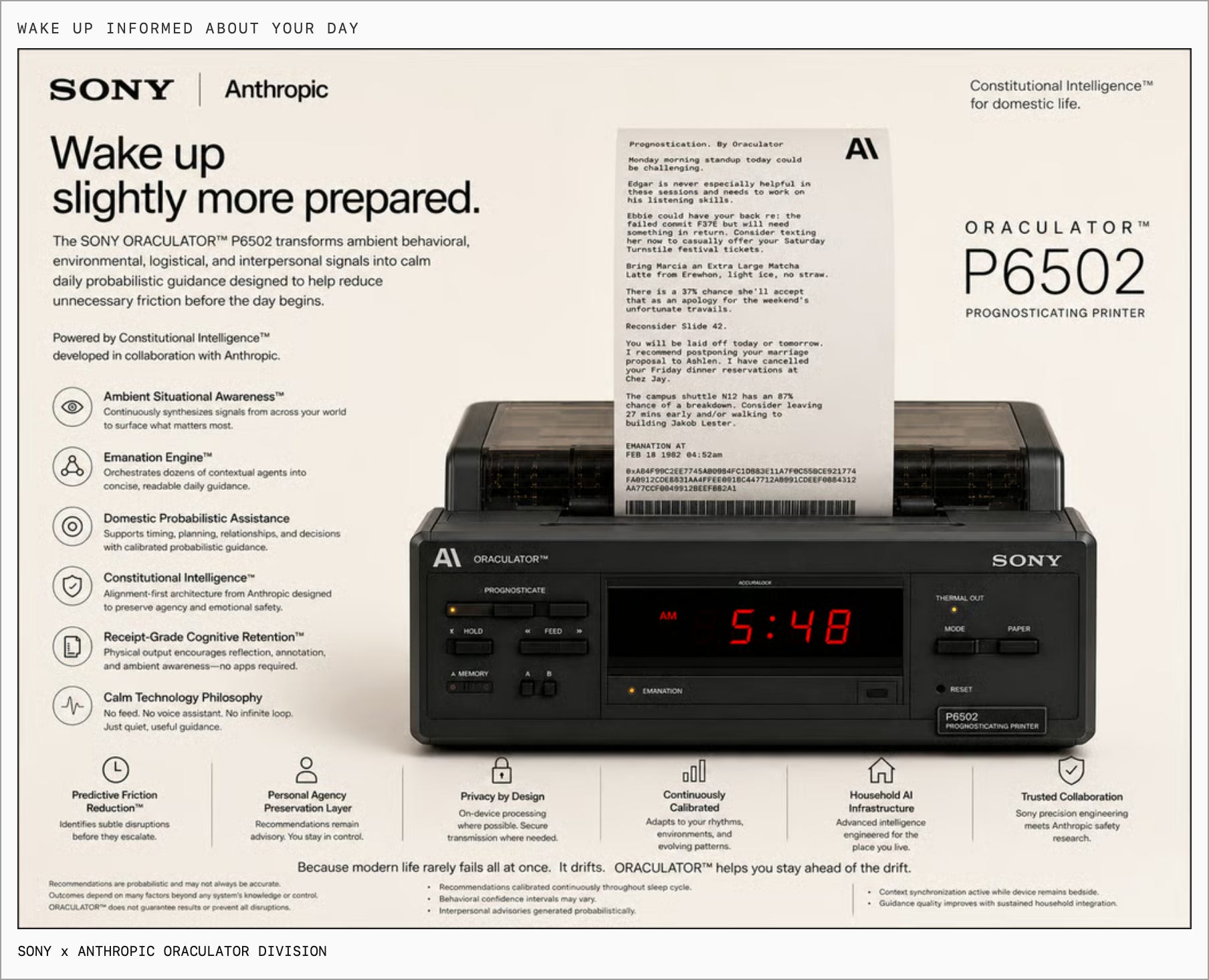
Employees now encounter AI Mark through a narrow chat pane embedded in the company’s internal tools. The pane follows them through design review, code review, launch-readiness documents, policy annotation, brand QA, and strategy templates. It does not appear as a face or avatar but rather as a status mark, and three confidence levels: “Aligned. Keep your job!”, “It’ll be a set of steak knives, then?”, and “Not really very Mark, is it?”
For many workers, the interface has replaced the old anxiety of guessing what leadership wants with the newer anxiety of being told quickly.
“I used to spend three days trying to figure out whether the button should say Continue or Get Started,” said the junior designer in the company’s creator monetization division. “Now I ask the Mark and the Mark says neither, because the experience should not have a button. I save time, but I also learn that the last three days of work were spiritually misdirected.”
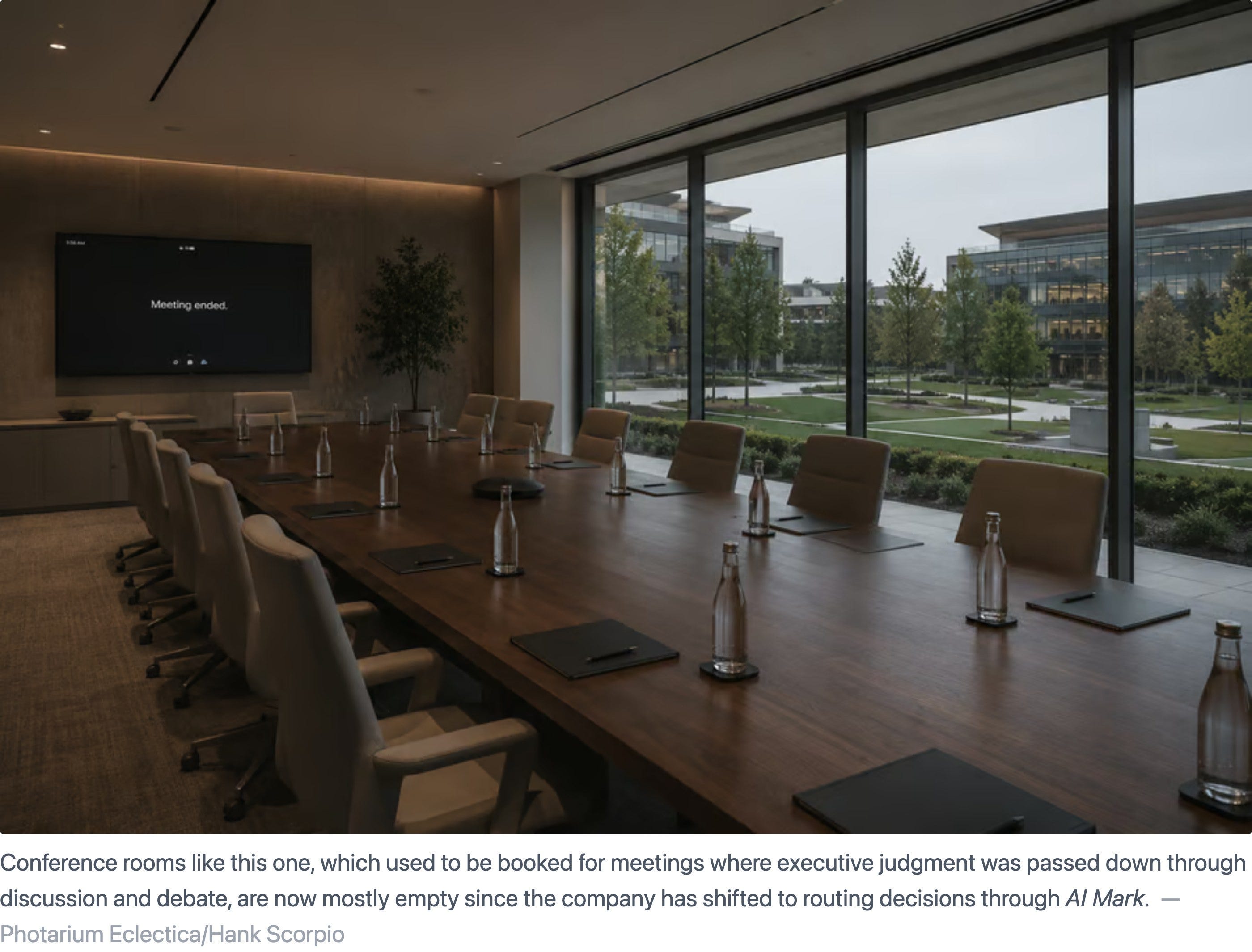
What’s In A Name, Anyway?
Outside the company, the rebrand has been greeted with confusion, jokes, and a brief surge in the stock price. Brand analysts called the move either disastrous or inevitable. Governance experts asked whether an AI simulation of a founder’s judgment creates a new kind of officer, policy, or record. The company said AI Mark is not a legal decision-maker and does not replace human accountability.
“Mark is a tool for surfacing aligned recommendations,” said Mark, with its spokesperson SKILL engaged. “Final authority remains with accountable leaders.”
By late afternoon on the first day, the west entrance sign had passed facilities review, brand review, accessibility review, and executive simulation review. A photo of the new sign was posted to the internal launch channel with approved alt text:
“The Mark wordmark appears at company headquarters during rebrand week.”
Within 78ms, AI Mark added a final comment: “Good,” it wrote. “But next time, try to make the alt text more concise. The word ‘company’ is redundant when the image is already in an internal channel, and ‘headquarters’ is implied by the context. Just say, ‘The Mark wordmark appears during rebrand week.’ That will save 7-9 tokens and reduce ambiguity.”
Source: Read this article on The Adjacency:
https://theadjacency.com/p/meta-renames-itself-mark--e1a599f0903f5e3fb2d71b24